
A thought is not necessarily a fact. A comment, a silence or a mistake can have several possible explanations. Cognitive distortions are thinking patterns that simplify, distort or select information and can make a situation harder to deal with.
This page introduces fifteen common patterns, with examples and ways to step back. Recognising them is not about blaming ourselves for thinking incorrectly; it is about examining interpretations more flexibly.
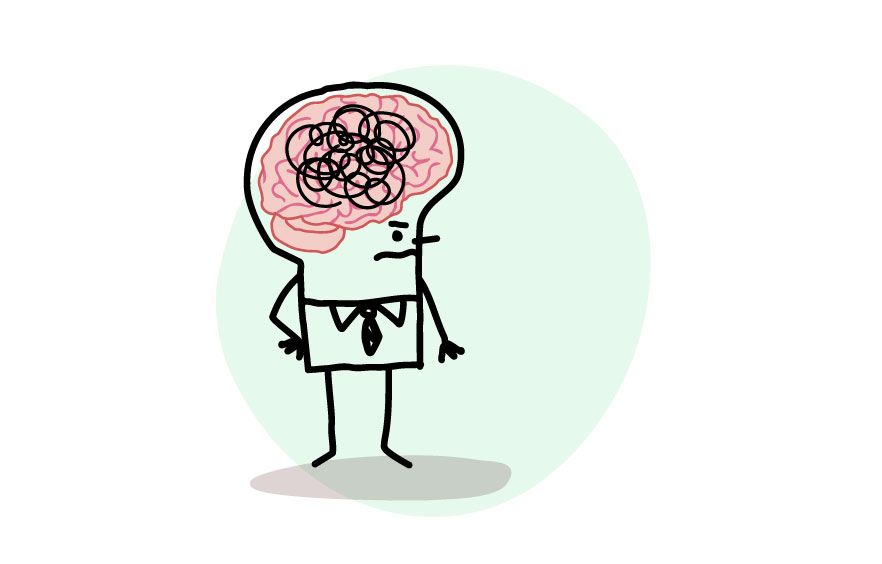
What is a cognitive distortion?
It can involve reaching a conclusion too quickly, making a global judgment or focusing only on negative information. Several patterns can appear in the same thought. Their names are educational signposts, not diagnoses or a list of personal faults.
A concern may also reflect a real difficulty. Stepping back does not mean denying facts, an injustice or another person’s responsibility.
Fifteen common cognitive distortions
All-or-nothing thinking
Reducing a situation to two extremes and overlooking the middle ground.
Example: “If my work contains one mistake, it is a failure.”
A more balanced perspective: Useful work can still have room for improvement.
Catastrophic predictions
Imagining a very negative outcome and treating it as certain.
Example: “I will fall apart during this meeting.”
A more balanced perspective: What is likely, and how could I cope with a difficulty?
Discounting the positive
Dismissing an achievement or positive feedback instead of including it in an assessment.
Example: “They only praised me to be polite.”
A more balanced perspective: What evidence would help me recognise my contribution?
Emotional reasoning
Treating a feeling as sufficient evidence of what is happening.
Example: “I feel unsafe, so this situation must be dangerous.”
A more balanced perspective: My feeling deserves attention; what facts describe the situation?
Labelling
Turning a behaviour or difficulty into a global judgment about a person.
Example: “I forgot that meeting: I am incompetent.”
A more balanced perspective: I made a specific mistake; it does not define all my abilities.
Magnification and minimisation
Exaggerating the importance of a setback or downplaying something favourable.
Example: “That hesitation cancels out everything I presented well.”
A more balanced perspective: How much of the whole presentation does this incident represent?
Mental filtering
Focusing on only part of the information, often the part that confirms a worry.
Example: “I only remember the critical comment among several pieces of feedback.”
A more balanced perspective: What other information have I left out?
Mind reading
Assuming that we know what someone else thinks without enough evidence.
Example: “I am sure she finds me boring.”
A more balanced perspective: Do I have direct information, or am I interpreting?
Overgeneralisation
Applying one particular experience to every future situation.
Example: “That conversation was difficult: every conversation will be difficult.”
A more balanced perspective: Does this experience really tell me what every other one will be like?
Personalisation
Interpreting an event as being about us while overlooking other explanations.
Example: “He has not replied: he must be angry with me.”
A more balanced perspective: What reasons unrelated to me could explain his silence?
Rigid shoulds and musts
Turning a preference into an absolute demand on ourselves or others.
Example: “I must always know what to say.”
A more balanced perspective: I would prefer to feel confident, but I can sometimes hesitate.
Jumping to conclusions
Reaching a conclusion too quickly from incomplete or ambiguous information.
Example: “I was not invited: they want to exclude me.”
A more balanced perspective: What information is missing before I can draw a conclusion?
Excessive blame
Assigning all responsibility to ourselves or others without considering different contributing factors.
Example: “If our project failed, it is entirely my fault.”
A more balanced perspective: What depended on me, other people and the circumstances?
Repeated what-if worries
Following one worrying scenario with another without returning to facts or a useful action.
Example: “What if I make a mistake, and then everyone notices?”
A more balanced perspective: Is there a concrete problem I can address now?
Unfair comparisons
Comparing our difficulties with a selective, favourable picture of other people.
Example: “Other people succeed at everything, unlike me.”
A more balanced perspective: Am I comparing similar situations with comparable information?
A practical example
Situation: a colleague approves your presentation and suggests two changes.
Automatic thought: “If she wants to change something, my work must be poor.”
Possible pattern: all-or-nothing thinking, alongside discounting positive feedback.
Alternative: “My presentation was valued. These two changes can improve it without cancelling its strengths.”
How can you examine a thought?
Describe the situation. Write down what happened without adding an interpretation.
Notice the emotion and the thought. What did you feel, and what went through your mind?
Review the evidence. What supports this thought? What qualifies it? What information is missing?
Consider another interpretation. Aim for a credible, balanced statement rather than a positive claim you do not believe.
Reassess and act. Notice any change in how you feel and, where possible, choose a small action suited to the situation.
How does this relate to psychotherapy?

Examining thoughts is part of cognitive behavioural therapy (CBT). It connects with attention to emotions and behaviour, as well as practical experiences.
Trial-Based Cognitive Therapy (TBCT), known in French as thérapie cognitive processuelle (TCP), also offers a structured way to examine automatic thoughts and negative core beliefs, considering both the evidence that supports them and the evidence that challenges them.
Related difficulties are discussed in the article on social anxiety. The aim is to develop a more flexible understanding of a situation and respond in a useful way.
If these thoughts become intrusive or disrupt everyday life, working with a professional can help you understand them better and identify a suitable approach.
Sources and references
Educational basis: Irismar Reis de Oliveira, Distorsions cognitives, working document in French. This overview paraphrases its fifteen categories and provides examples adapted for online reading.
Judith S. Beck, Cognitive Behavior Therapy: Basics and Beyond, 3rd edition, 2020. Beck Institute worksheets cover automatic thoughts and cognitive distortions.
NHS, Every Mind Matters: Thought record.