

Meditation or mindfulness-based therapy is a natural process that Westerners have just discovered. Used since time immemorial in Asia, this method has become very fashionable in recent years. We are not only faced with a fashionable phenomenon, because many neuroscientific works, supported by medical imagery, objectively demonstrate that the brain is transformed and remodelled by contact with this practice. Many studies point to a positive modification of certain behaviour problems in people who practice meditation regularly.
This page introduces mindfulness meditation, MBSR and MBCT. Explore the mindfulness resources below or contact Franck Dibouës about a session in Singapore or online.
What does it mean to meditate?
It is to stop moving and to turn towards one’s internal sensations, one’s body perceptions such as breathing, a part of the body, a pain, an uncomfortable area, the flow of one’s thoughts… It is to observe without entering into the mental process of identification with thoughts and sensations… It is to be attentive to what is happening inside and/or outside oneself without sticking, to identify oneself with what these sensations trigger in particular in the form of thoughts. It is to be attentive to what is happening in oneself and/or around oneself with sufficient distance that one becomes the observer of oneself. Describing meditation in words is not easy since it is above all a sensory experience. To meditate is to observe what is happening in oneself without judging, without putting a word on the observation (the opposite of what the shrink learned to do at university), without expecting any particular change (very difficult to do) and without holding on to what is happening (by association of thoughts). For example, I think of something painful, not digested and I observe, I feel without clinging to what presents itself, without sinking into distress as most people in crisis do and sinking into themselves…
Mindfulness Meditation
The meditation practiced nowadays by western therapists is mostly the one qualified as mindfulness. In practice, it is proposed to focus attention on the present moment, to open, to widen the attention to the maximum on everything that manifests itself in the mind. The attention can be focused on bodily sensations such as breathing, heat, cold, on what we hear. To sum up, attention observes what presents itself without rejecting anything and without becoming attached to it… For those who are familiar with CBT it is a form of exposure, it is the opposite of the processes of avoidance and escape. We look “straight in the eyes” at what bothers us, what makes us suffer, but which presents itself to us.
In meditation or mindfulness-based therapy, it is suggested to observe, to experience what comes to mind and not to try to put words to or analyze the experience. In short, it is the opposite of what has been proposed in psychotherapy in the West for more than a hundred years.
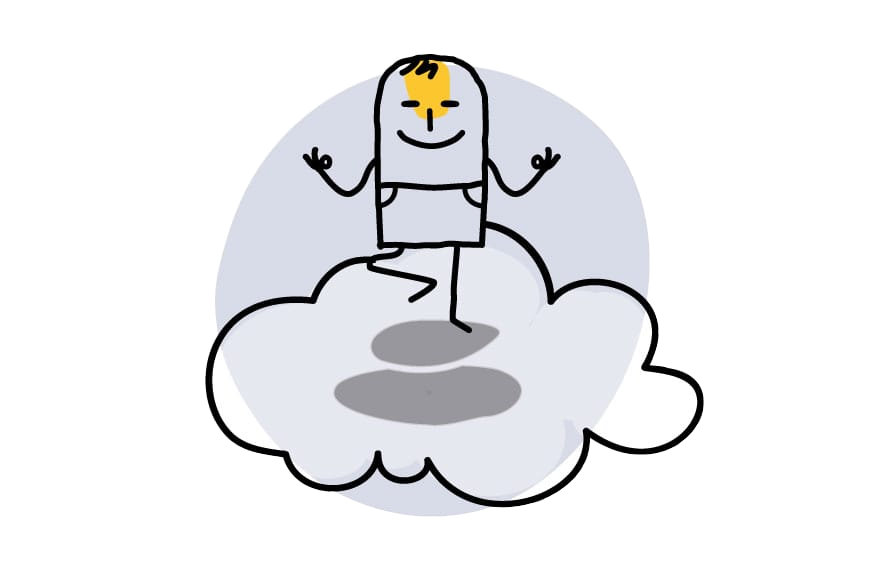
Meditation is good for whom and for what?
MBSR and MBCT are two mindfulness-based programmes with different aims. Both are introduced below.
MBSR was developed in 1979 by Jon Kabat-Zinn at UMass Memorial Medical Center. MBSR stands for Mindfulness-Based Stress Reduction. Its principle common to other meditation methods is not to run away from stressful situations and not to try to distract oneself from them by thinking or doing something else. To do something else is to choose one or more avoidance or escape strategies such as leisure, pleasure, work or any other conduct… In an MBSR program, on the contrary, we learn to welcome in this state of receptivity proper to meditation these painful, unpleasant psychological and physical phenomena so as not to be manipulated by them. Many controlled studies have shown a significant reduction of stress in people who practice MBSR. This technique is recognized by the scientific community as effective in reducing the negative effects of stress.
MBCT: This method was codified and conceptualized by Zindel Segal and his colleagues in Toronto, Canada. The indication is the prevention of relapse of depression through a combination of meditation exercises and cognitive therapy. The aim is to better tolerate depressive thoughts and to be less influenced by them. This method is scientifically validated and its effects are significantly positive in order to stem the relapse of depressive episodes.
In an article in the journal Cerveau et Psycho (article in French) of September and October 2010, Christophe André identifies other therapeutic methods related to meditation or mindfulness-based therapy, DBT (Dialectical Behavior Therapy), OFT (Open Focus Therapy) and the Vittoz Method.
What meditation is not?
Something based on reflection: We rather focus on sensations, on what comes to mind without putting words or value judgements in it
To make the emptiness in his head: It is a question of observing the thoughts without letting oneself be captured by them. It is not identifying, not “sticking” to what is going on in one’s head, but on the contrary, positioning oneself as an observer of one’s own thoughts. Observing thoughts and letting them go…
A religious approach: But many religions have integrated it into their practice because it is a therapeutic exercise. Meditation focuses on observing what is, in other words, reality as it presents itself to us.
A method of relaxation: Even if meditation has points in common with sophrology or relaxation, the objective of a meditative practice is not to obtain a state of relaxation, but “an observer’s point of view” by trying to be as neutral as possible about what is happening in oneself in terms of thoughts, emotions, physical sensations. This can therefore lead to a state far removed from relaxation since we will also be crossed by things that we do not like…
Willem Kuyken: Wake Up! Oxford Mindfulness, September 2024. An introduction to attention, awareness and the place of mindfulness in everyday life.
Willem Kuyken: How We React to Stress and Difficulties. Oxford Mindfulness, February 2025. A discussion of habitual stress responses and ways to respond more deliberately.
Further resources
Here you will find guided meditations in English by Daniel J. Schmidt, creator of the three wonderful Samadhi films.
Bibliography in English
 Get the bookBook preview
Willem Kuyken. Guilford Press, September 2024.
A guide to building a sustainable mindfulness practice and applying it to everyday challenges.
Publisher details
Watch the Oxford Mindfulness series and read the session summaries.
Practise with Petit BamBou

Explore Petit BamBou