

What is D-MER?
Have you heard of D-MER[1]? When I first discovered this concept, it was new to me. The name stands for Dysphoric Milk Ejection Reflex.What is dysphoria?
Dysphoria is an unpleasant disturbance of mood. In contrast to euphoria, it involves distressing or painful feelings. People with depression or anxiety can experience dysphoria, but dysphoria can also occur without either of these disorders. In D-MER, these feelings occur just before the milk-ejection, or let-down, reflex. Research articles on D-MER can be found on PubMed.How does D-MER present?
Women who experience D-MER describe dysphoria just before, or for a few minutes around, milk let-down. It may occur at the first let-down or at each let-down. Around this reflex, negative feelings such as sadness, hopelessness, melancholy, anxiety, anger, nervousness, self-disgust, terror, panic, tension or agitation may appear suddenly. Unpleasant sensations in the stomach may also occur. Three levels of intensity are described: mild, moderate and intense. These are subjective and reflect the mother’s experience: the more distressing the dysphoria, the greater its perceived intensity. Understanding that these feelings may be linked to a physiological response can make the experience easier to cope with than facing it in isolation.
What causes D-MER?
Its mechanisms are not fully understood. The French article discusses a hormonal explanation involving changes in dopamine, a neurotransmitter involved in reward. This remains an explanation under investigation rather than a complete account of the condition.What is D-MER not?
D-MER should not be treated as a failure of willpower. Telling a woman to pull herself together or simply put up with it can add to her guilt. Someone experiencing D-MER may already worry that she is a bad mother; blame does not help. Nausea may accompany D-MER, but it is not the same experience. D-MER is distinct from the baby blues and postnatal depression: the characteristic distress is closely linked to milk let-down. Other mood difficulties can also be present and deserve attention in their own right.How can D-MER be managed, and how may it develop?
The French article discusses the lack of an established specific medical treatment at the time it was written. It mentions reports of improvement with medicines affecting dopamine, while noting that these were not approved specifically for D-MER. These observations should not be read as a recommendation to take medication without clinical advice. Recognising the experience and understanding its possible physiological basis may reduce some of the distress it causes. Its course varies: symptoms may ease during breastfeeding or around weaning, while some women describe more persistent difficulties. When a woman understands what she is experiencing, she may feel less pressure to stop breastfeeding immediately and better able to cope with the dysphoria. This is one reason why sharing information about D-MER matters. Social and psychological support may help with its emotional impact, although experiences differ. Understanding a reaction does not necessarily make it possible to control it. The original article discusses possible physiological mechanisms to explain why some women find it particularly hard to step back from their emotions. These explanations should be regarded as hypotheses, rather than proof that a particular brain region prevents emotional control. Information and discussion may help some women gain perspective, but not everyone experiences this in the same way. Avoid stigmatising or blaming someone who cannot distance herself from the feelings: this may increase stress. Psychotherapy may help women find ways of coping with the experience, rather than directly removing the physiological reflex. Peer-support groups are listed below. In these discussions, some people describe allowing the dysphoria to pass rather than fighting it: drinking a glass of water, reading something or letting the emotional storm move through. Trying to force the feelings away through willpower alone can be exhausting and add to stress. D-MER.org provides information in English. Miss Brownie has written about D-MER on Les Vendredis Intellos (in French). Here is the English-language Facebook group associated with Alia Macrina Heise, who helped introduce the concept of D-MER. You can request to join for discussion and peer support. Elise Bolduc offers peer support through her French-language Facebook group. [1] Ureño TL, Buchheit TL, Hopkinson SG, Berry-Cabán CS. Dysphoric Milk Ejection Reflex (D-MER): A Case Series. Breastfeeding Medicine, January/February 2018; 13(1): 85–88.Recent reading and video
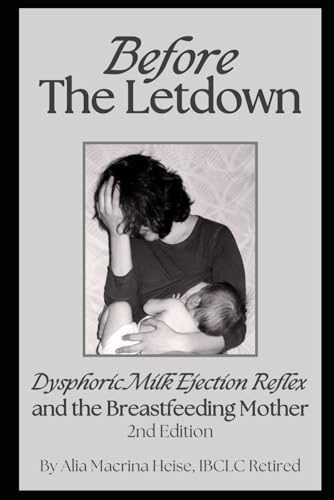 Get the bookBook preview
Alia Macrina Heise. English-language edition, July 2024.
A specialist lactation resource by the clinician who helped identify D-MER. It combines practical support with an evolving evidence base.
Author’s book presentation
Shannon M. Clark, MD, “Dysphoric milk ejection reflex”, January 2025: a brief educational video about the experience and where to find further information.
For a longer discussion, listen to “Breastfeeding and D-MER”, Emma Pickett IBCLC with Alia Macrina Heise and Jen Hall, 11 February 2025 (audio, 69 minutes).