

The following near-death experience accounts are particularly moving.
I do not take a position on the nature of the episodes these people describe. Anyone who, like me, has taken a close interest in end-of-life experiences for some time eventually ceases to be surprised by the content of certain NDEs.
Nevertheless, some accounts are more surprising, more moving and more overwhelming than others.
A clinical psychologist for twenty years, I have studied NDEs and related phenomena for many years.
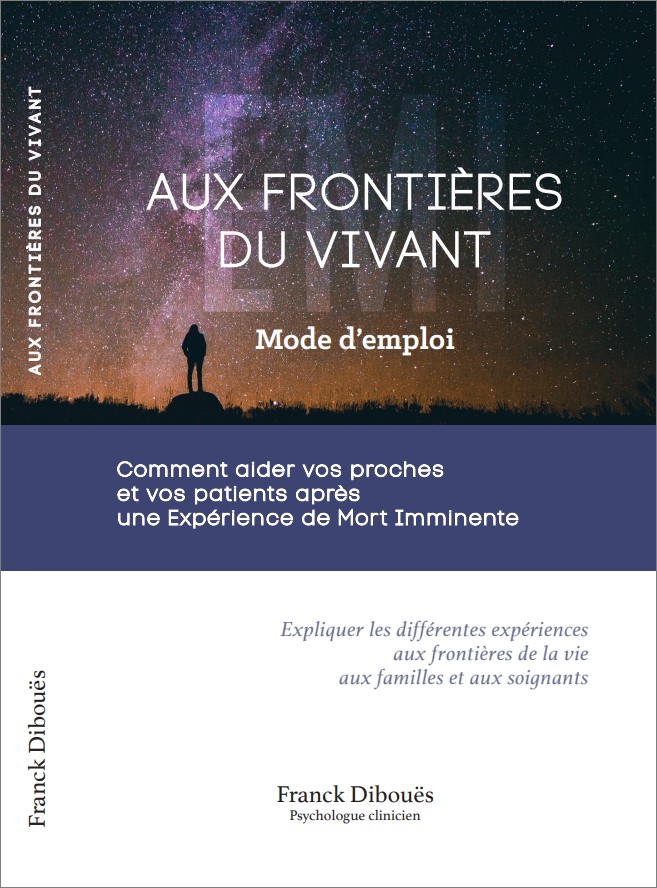
I have also published Aux frontières du vivant, mode d’emploi, a French-language book devoted to understanding near-death experiences and supporting those who have them.
Beatrix Keller’s moving near-death experience account
Beatrix Keller describes two NDEs: one during childbirth and another following a miscarriage. For her, giving birth has been a particularly dangerous experience:
In her first NDE, Mrs Keller describes the following features:
- During the out-of-body phase, her perceptions and her view of her own body are particularly rich and unusual.
- The distance Mrs Keller describes between herself and her body is typical of NDE accounts. She explains that she no longer identified with that body and felt liberated, understanding herself as a spiritual being.
- As often happens in these accounts, she tries to communicate with the people around her but cannot. She wants to tell the medical team to stop because her body no longer matters to her. She tries to take the doctor’s arm, but physical contact is impossible. Experiencers frequently describe this.
- Mrs Keller reports hearing wonderful, heavenly music, another recurring feature in NDE accounts.
- Mrs Keller says she travelled in consciousness to visit her first child, who was staying with her parents. While watching her son, she describes a psychic vision of his future. This contraction or overlapping of time is another recurring feature in NDE accounts.
- As in many experiencers’ accounts, the painful decision to return to earthly life comes with the awareness of what their children would face if left orphaned. Mrs Keller decides to return to her body to care for her son, out of a sense of duty.
- Returning to an injured body is difficult and painful, especially compared with the fullness and bliss felt during the NDE. In her account, a powerful sense of duty makes that return possible. In other accounts, experiencers describe being sent back without being given a choice.
- One unusual feature is that Mrs Keller says she brought the joy of her NDE back with her. Other experiencers struggle after returning. These difficulties of readjustment are sometimes compared with those faced by former prisoners or combat veterans.
In her second NDE, Mrs Keller describes several familiar features:
- She is drawn into a tunnel that opens onto an immense space containing a city of light. She recognises this place as home. She then feels pulled away, back through the tunnel towards her physical body, around which medical staff are working. She describes moving between her body and the city several times. A city of light appears in many experiencers’ accounts.
- Mrs Keller describes a recurring feature of NDE accounts concerning light: in this city, the light comes from the objects themselves. The city is not lit from outside; it radiates light. This resembles descriptions of the being of light, whose very strong yet gentle light is never dazzling. I am struck by the consistency of these descriptions across periods and cultures.
I pause here, because the next part of Mrs Keller’s account is particularly unusual.
Some experiencers say they return with mediumistic abilities; others describe psi phenomena. These may be temporary or lasting. Mrs Keller says she has been in contact with invisible presences since her NDE…
I can already imagine some of my psychologist and psychiatrist colleagues concluding that she is psychotic, delusional or hallucinating. I draw none of those conclusions from this account. In my view, phenomena surrounding death remain unexplained, and the reductionist materialist model cannot provide a satisfactory explanation.
Our usual framework for interpreting reality does not work here. We need to acknowledge that, even when it makes people uncomfortable.
This does not mean that every account should be accepted uncritically. Among people reporting experiences at the boundaries of life, some may also have a psychotic disorder, while others may invent what they describe.
In my view, the many accounts reported around the world cannot be explained through materialist interpretations. I discuss and challenge those hypotheses in Aux frontières du vivant, mode d’emploi.
- The next part of Mrs Keller’s account concerns mediumistic experiences. She recalls having lived in a particular place in a previous life. She says she first visited it in consciousness during meditation, then found and visited the place physically.
- She describes coming close to death again following a severe allergic reaction. This time she felt she was at the threshold of death, aware of an afterlife around her, but without an out-of-body experience, a tunnel or the other usual features of an NDE.
- This later experience nevertheless included a more familiar feature: contact with deceased people who had come to welcome her. She says she had already been in contact with them while meditating on the evening before the event.
René Volken’s near-death experience
Mr Volken says he did not know what a near-death experience was before having one himself.
An NDE can also occur in someone who has never taken an interest in the subject or encountered the concept.
Mr Volken adds that, before his NDE, he was a materialist and did not think consciousness could survive the physical body:
Mr Volken describes the following events:
- A few days after his wife’s death, he went to hospital with severe abdominal pain. He lost consciousness and found himself in her presence. He describes neither leaving his body nor passing through a tunnel. His wife told him to return, look after their children and promise not to remain alone. Time seemed to expand: their meeting felt like an eternity. This loss of ordinary time, or overlap of past, present and future, is a recurring feature in NDE accounts. His emotion is palpable, and he has tears in his eyes as he describes seeing his wife. His surroundings were entirely white: no wonderful meadow or spiritual beings, but a whiteness he could not put into words. This illustrates the difficulty of describing an NDE. He regained consciousness in his physical body in a hospital bed.
- On waking, he says he saw a woman he had occasionally noticed in a restaurant standing beside his bed with her hand on his forehead. A moment later, she had disappeared…
- He then learned that he had experienced a cardiac arrest lasting nine minutes. Cardiac arrest rapidly compromises the brain’s blood supply; the precise timing of a remembered experience cannot be established from the account alone.
- In my view, reductionist materialism contributes to the dismissal of experiences at the boundaries of death. Patients and families often receive no information about them in hospital. After a cardiac arrest, I believe patients should routinely be asked whether they remember anything from their period of apparent unconsciousness and whether they would like to discuss it. If so, staff could explain that other people report such experiences and that their meaning remains open to discussion. Healthcare professionals should neither promote spiritual beliefs nor dismiss what patients describe.
- After leaving hospital, Mr Volken sought out the woman he had seen in the restaurant, and a relationship quickly developed. He told her about his vision of her. She said she too had experienced a vision of him at the same time, in a different place. Mr Volken now lives with her!
- He interprets these events as his wife having sent this woman to share his life.
- Like many experiencers, Mr Volken says he no longer fears death. He now looks at existence with greater distance and a spiritual perspective.
Sarah Friederich’s shared-death and out-of-body experience
Franz Dschulnigg introduces this interview as an out-of-body experience.
Mrs Friederich does describe awareness outside her physical body, but she also describes a shared-death experience.
While swimming on their honeymoon, Mrs Friederich and her husband were caught by waves that carried them out to sea. Her husband drowned, while she struggled to reach the shore. The events she describes took place on the beach in these tragic circumstances:
- During attempts to resuscitate him, Sarah Friederich became aware that her husband’s jaw was already stiff. She understood that he had died and would not return. She then describes noticing a spiritual presence beside her and communicating with it. She says she witnessed both her husband’s life review and her own. She describes an immense letting go alongside a profound psychological collapse as she understood that his time had come but hers had not. At that moment, she says she surrendered everything and entered a mystical state of consciousness involving an out-of-body experience, contact with light and a feeling of boundlessness.
- Afterwards, she describes a period of grief, transformation and integration, as many experiencers do. She too says her fear of death disappeared. What makes this account distinctive is the combination of bereavement and the integration of an end-of-life experience.
Conclusion
If these questions intrigue or fascinate you, you can explore them further in my French-language book Aux frontières du vivant, mode d’emploi. It looks in greater depth at understanding NDEs and supporting people who experience them.
It offers practical ways to help experiencers integrate what happened, and to respond to phenomena such as visions of the dying or subjective experiences of contact with someone who has died.
I wrote this book for experiencers, their loved ones and healthcare professionals.
If you or someone close to you has had an NDE, and the changes that followed are difficult to adjust to, this book aims to help you:
- Understand why NDEs and related phenomena are dismissed in Western societies.
- Gain perspective on the adjustments in relationships that may follow an NDE.
- Understand that NDEs and related phenomena are real experiences that can profoundly affect people and their loved ones.
- Maintain your relationship with the person.
- Better understand what the person is experiencing and feeling, and make room for their difficulties so you can support them through this crisis.
- Listen to people who have experiences at the boundaries of life and help them integrate those experiences into their lives.
The book is also intended for healthcare professionals who want to:
- Understand why their university training did not prepare them to support experiencers through these difficulties.
- Improve care and support for patients who have had an NDE or a related experience, and for their loved ones.
- Develop an effective psychotherapy plan with an experiencer, for psychotherapists, psychologists and psychiatrists.
- Anticipate the personality changes that may gradually emerge in the months and years after an NDE.
- Assess more precisely how a hospital department can welcome experiencers and respond to related phenomena.
- Assess patients’ NDEs using standardised tools such as the Greyson Scale and the NDE-C Scale.
- Know what to say and do, and what is best avoided, when supporting people who describe experiences at the boundaries of life, such as visions of the dying, terminal lucidity or subjective contact with someone who has died, as well as their loved ones.
You can explore and buy the French-language book on Amazon using the button below:
Recommended article
For further near-death experience accounts, see this article featuring three more personal accounts.