
Raymond Moody and near-death experiences
In 1975, American psychiatrist Raymond Moody published Life After Life, which went on to reach a very wide international readership. Moody collected accounts from people who had come close to death and described what he called a near-death experience, or NDE. In French, the terms EMI, EFM and EMP have also been used. Jean-Jacques Charbonier has favoured the expression “temporary death experience”, reflecting his interpretation of the phenomenon.What is a near-death experience?
An NDE is an unusual experience of consciousness, often reported around a life-threatening event such as cardiac arrest. Similar experiences have also been described in other circumstances: altered states of consciousness, meditation, intense fear, orgasm or without an obvious trigger. A few people report related experiences while someone else is dying, as discussed in Jean-Pierre Postel’s account. People often find these experiences difficult to put into words. Their accounts may have a spiritual quality and involve unusual perceptions of time, space or location. Comparisons with mythology or quantum physics can be evocative, but they are analogies rather than established scientific explanations.A commonly described sequence
A person who has had an NDE is sometimes called an “experiencer”. Some describe becoming aware of being outside their body without understanding what is happening. During a life-threatening event, they may feel that they are dying. Pain may seem to disappear and give way to an expansive sense of peace and calm. They may describe feeling detached while observing people attempting to resuscitate their body. Some feel so well that they cannot understand why others are worried. They may want to reassure those around them, yet feel unable to communicate or interact physically. Some describe passing through doors or walls, appearing beside a distant loved one after thinking of them, or feeling held near a ceiling. Others describe a dark or frightening setting. These are descriptions of subjective experiences, not confirmation that a person physically travelled outside the body. The account may then move into what is called a “transcendent” phase. Some narratives involve only an out-of-body experience; others include further elements experienced as deeply spiritual.The transcendent experience
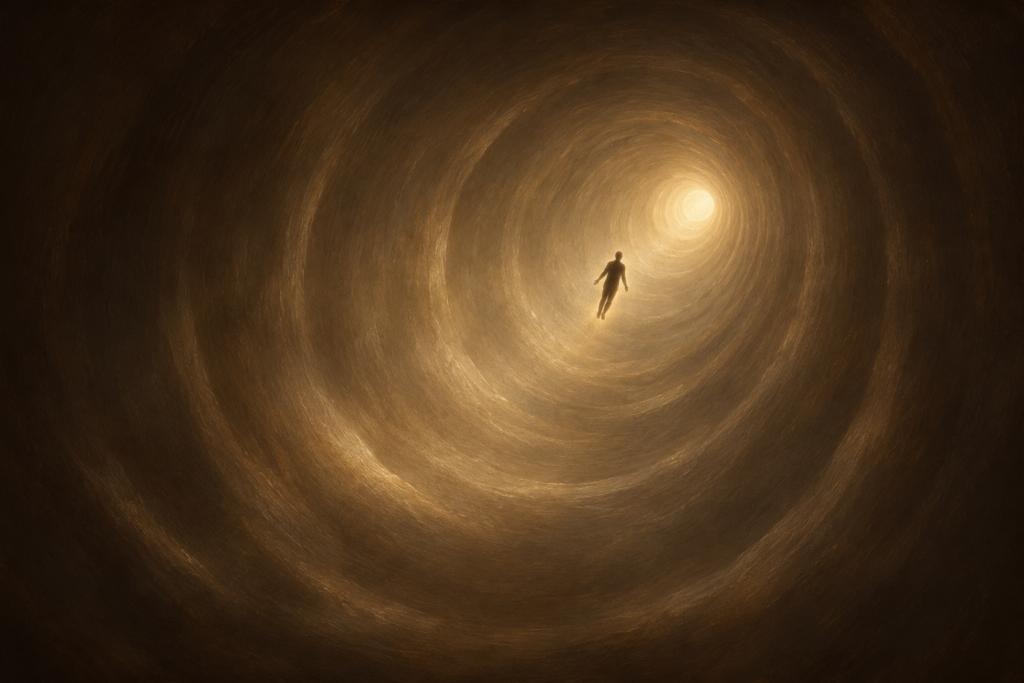
People may describe a light appearing gradually and drawing them towards it without dazzling them, sometimes through a tunnel. Beyond it, they may report remarkable landscapes and a sense of unity with everything. Sensory perceptions can feel entirely unfamiliar, including the impression of seeing in all directions or from several viewpoints at once. I compare this with quantum entanglement; this comparison should be understood as an analogy, not a demonstrated mechanism. Accounts may include encounters with familiar or unfamiliar beings, deceased relatives, or people who seem intimately known despite never having been met in ordinary life. Children’s accounts are discussed in this documentary, particularly between 5:57 and 11:40. In my view, children’s reports are particularly intriguing because the accounts discussed here do not simply reproduce the attachment figures one might expect. This is an interpretation of the testimonies rather than a demonstration of their cause. Some people describe a life review in the presence of a benevolent being or light. They feel invited to consider how they have loved or treated others, and experience a deeply personal evaluation of their life. During this review, a person may feel that they are reliving events from the perspectives of everyone involved, including the feelings their behaviour caused in others. A whole lifetime may seem to pass in a moment, without a clear sense of before, during or after. Some describe sadness or regret and a wish to return to ordinary life to make amends. Others report scenes they interpret as glimpses of the future, while feeling that much of what they experienced cannot be brought back into memory. Nicole Dron has described the frustration of returning with only fragments of what she felt she had been shown. Some later events may be interpreted as fulfilling those impressions. Other accounts involve a sense of complete knowledge or understanding. These are elements of the testimonies and should be distinguished from independently verified knowledge or predictions. A final boundary is another recurring theme: crossing it seems to mean that there can be no return. People may describe being told by deceased relatives or beings of light that it is not their time, that tasks remain, or that they must return. Some feel that the choice is left to them. Many describe reluctance to leave a place where they felt exceptionally well. Concern for children or loved ones is sometimes given as the reason they accepted a return. Others describe a more abrupt transition. In the account associated with Pam Reynolds, returning to bodily awareness was compared to an abrupt plunge into cold water. Returning can feel painful or distressing, especially when there are serious physical injuries. Ordinary problems and bodily limitations return too. Some people describe their body as unexpectedly cramped, like clothing that is too tight. NDE accounts vary between people and cultures, while sharing certain recurring features. No two accounts are identical, and not every experience contains all of the elements above. Descriptions interpreted as resembling NDEs can also be found in ancient texts.A phenomenon with a long history
Moody helped popularise the subject, but he was not the first to explore experiences around death. Russell Noyes and Elisabeth Kübler-Ross wrote about dying and related experiences during the 1960s and 1970s. Shamanic, philosophical and religious traditions also contain narratives that invite comparison.
The story of the soldier Er in Plato’s Republic, and Paul’s account in 2 Corinthians 12:1–10[1], are examples that invite comparison. Hieronymus Bosch’s Ascent of the Blessed depicts a tunnel that some viewers associate with modern NDE accounts.NDEs and mountaineering
French psychologist Victor Egger (1848–1909) discussed experiences around death in Le moi des mourants in 1896. He considered the work of Swiss geologist Albert Heim (1849–1937), who collected accounts from climbers describing extraordinary experiences during falls. Heim himself had survived a fall of around twenty metres. In their discussion of dying during falls, Russell Noyes and Roy Kletti report Heim’s account of reviewing his life as if watching a performance, accompanied by a striking sense of peace rather than pain or conflict[2].NDEs, cardiac arrest, resuscitation and the internet
Many NDE reports come from survivors of cardiac arrest. Dutch cardiologist Pim van Lommel published a study in The Lancet in 2001. The figures cited in this article are around 10–15% of cardiac-arrest survivors reporting an NDE in the discussion of van Lommel’s work, and up to 70% among children surviving cardiac arrest in an estimate attributed to paediatrician Melvin Morse. These are historical estimates from particular reports, rather than universal rates. More widespread resuscitation has enabled survivors to recount experiences associated with medical emergencies. The internet has also made testimonies much easier to share.
There is debate about how to interpret these accounts. My concern is that someone describing an extraordinary experience may sometimes encounter dismissal or ridicule rather than careful listening. The experience can be important to the person even when its mechanisms and interpretation remain uncertain. Physiological research, including work on terminal changes in neuronal activity, explores aspects of the dying brain; it does not settle every question about reported subjective experiences. A respectful clinical response need not assume either a supernatural explanation or that the person’s story is meaningless. People may feel vulnerable and unsettled afterwards, and a tactless response can add to that distress.
Among the people who have explored this subject are Raymond Moody, Jean-Pierre Jourdan, Jean-Pierre Postel, Pim van Lommel, Steven Laureys and Jean-Jacques Charbonier, alongside organisations such as IANDS. Other professionals involved in this field include psychologist Éric Dudoit, psychotherapist Claude Charles Fourrier and biologist Sylvie Déthiollaz. Their approaches and interpretations differ. In France, authors such as François Brune and Jean Prieur also contributed to the subject’s wider public visibility.
After an NDE: what can someone do with such an experience?
People may find it easier to discuss an NDE now than they did in the past. Nicole Dron has described waiting around ten years before speaking about the experience she had at the age of 26, after reading Moody’s book. Something experienced as profoundly meaningful may be difficult to communicate without fear of being misunderstood. Returning to everyday life can be challenging, with a renewed awareness of bodily limits and a frustrating inability to recall every detail. Some people describe a lasting change in their relationship with life and reality, alongside a strong longing for the experience. Loneliness, isolation or feeling misunderstood may contribute to low mood. Returning to ordinary life is not always emotionally straightforward.
Some experiencers describe everyday life as less real than what they felt during the NDE, as though ordinary existence were a stage. Values may change: relationships, compassion and care for others can become more important, while material concerns recede. These are reported changes in perspective, rather than conclusions everyone shares.
An NDE does not necessarily lead someone towards organised religion. Some describe a more personal spirituality and question beliefs they previously held. Integrating an experience that lasted only moments may take years. P. M. H. Atwater has discussed major relationship changes after NDEs; she has proposed that 70–80% of experiencers divorce within two years of an NDE. This is a claim attributed to her, rather than an established prediction for an individual. People may need time, understanding and support to find their place again.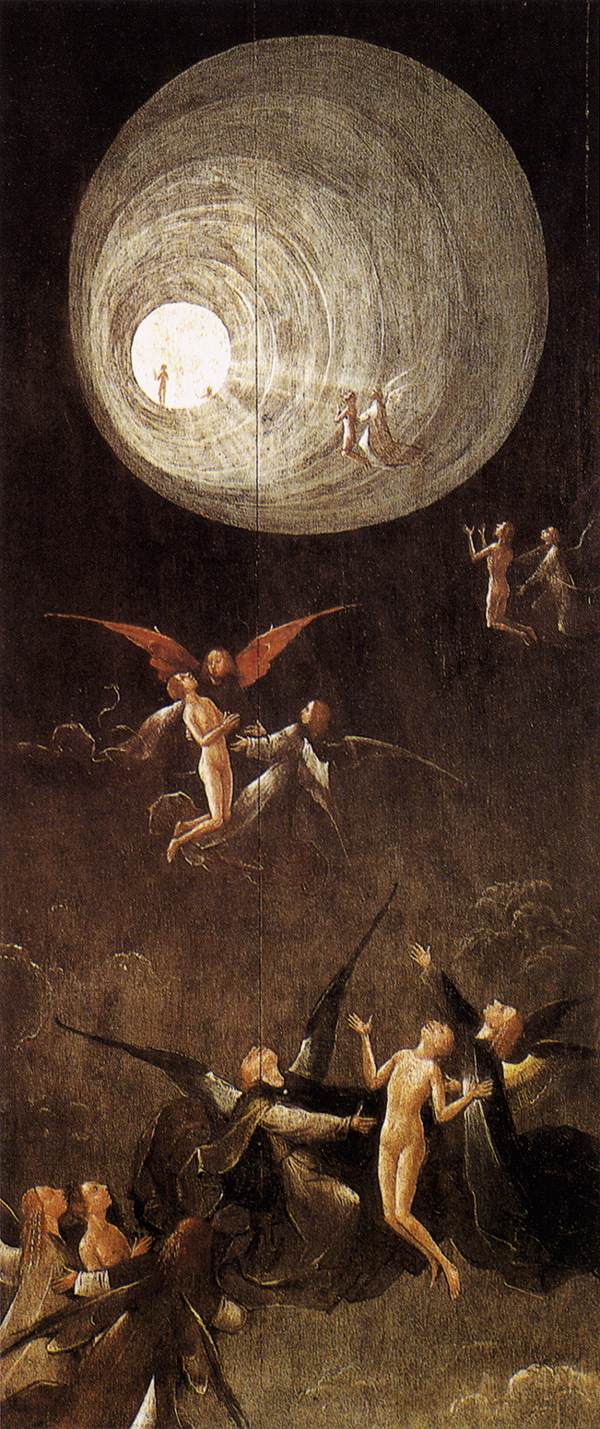
Videos in English
The following selection brings together the testimonies and films discussed on the French version of this article that are available in English or with English subtitles.
Personal accounts
Andréa Pfeifer
English voice-over.
Nicole Dron
English voice-over. This interview recounts Nicole Dron’s experience following childbirth.
Heidi Z.
English voice-over.
Joachim Schoss
English voice-over.
Isabel Waller-Rigo
English voice-over.
Samira Henning
English voice-over.
René Volken
English voice-over.
Beatrix Keller
English voice-over.
Sarah Friederich
German original with English subtitles. Select English using the CC button if needed.
Michael Rudigier
English voice-over.
Documentary
En Conscience
French original with an English dubbed audio track available in YouTube’s player settings. Select English under Audio track.
Samadhi films
Samadhi, Part 1: Maya, the Illusion of the Self
Original English-language version, directed by Daniel J. Schmidt.
Samadhi, Part 2: It’s Not What You Think
Original English-language version, directed by Daniel J. Schmidt.
NDE video playlist
Browse the videos using the playlist menu in the player. Open the full playlist on YouTube.
Recent research and English-language reading
 Get the bookBook preview
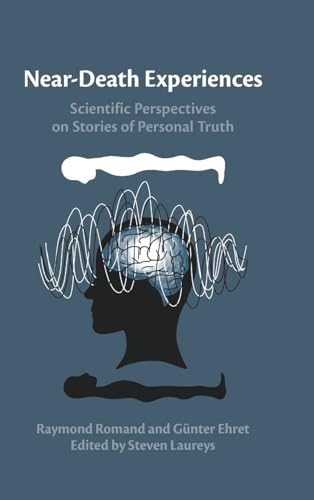
Raymond Romand and Günter Ehret. Edited by Steven Laureys. Cambridge University Press, 2025.
An academic synthesis integrating historical, clinical, psychological and neuroscientific approaches to near-death experiences.
Publisher and contents
 Get the bookBook preview
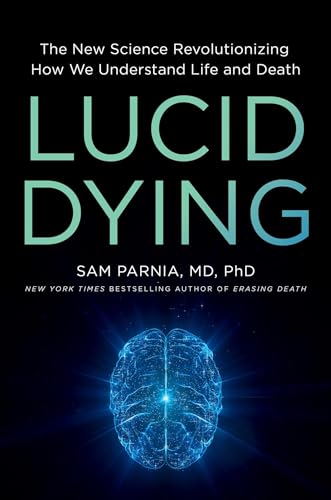
Sam Parnia. Grand Central Publishing, 2024.
An account of resuscitation research and recalled experiences around cardiac arrest, presenting the author’s interpretation of this developing field.
Publisher and edition
Bruce Greyson introduces After in his original English-language book trailer. A researcher’s overview of the questions explored in his work; personal accounts and interpretations should be distinguished from established mechanisms.
For a complementary neuroscientific framework, see Martial and colleagues, “A neuroscientific model of near-death experiences” (2025). This research proposes a model of the experience; the existence of vivid recollections does not by itself settle metaphysical claims about consciousness after irreversible death.
Historical reference in English
 Get the bookBook preview
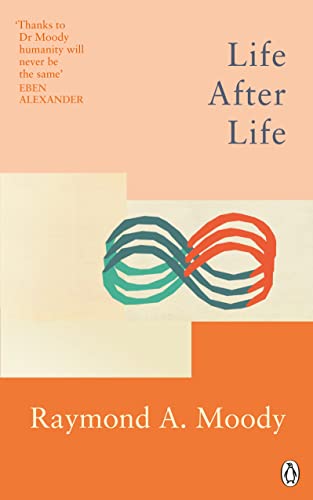
Raymond Moody. Rider Classics, English-language edition, 2022. Originally published in 1975.
The historical book discussed in the opening of this article, presented in an English edition. Its role in popularising NDE accounts should be distinguished from later research.
Publisher and English edition